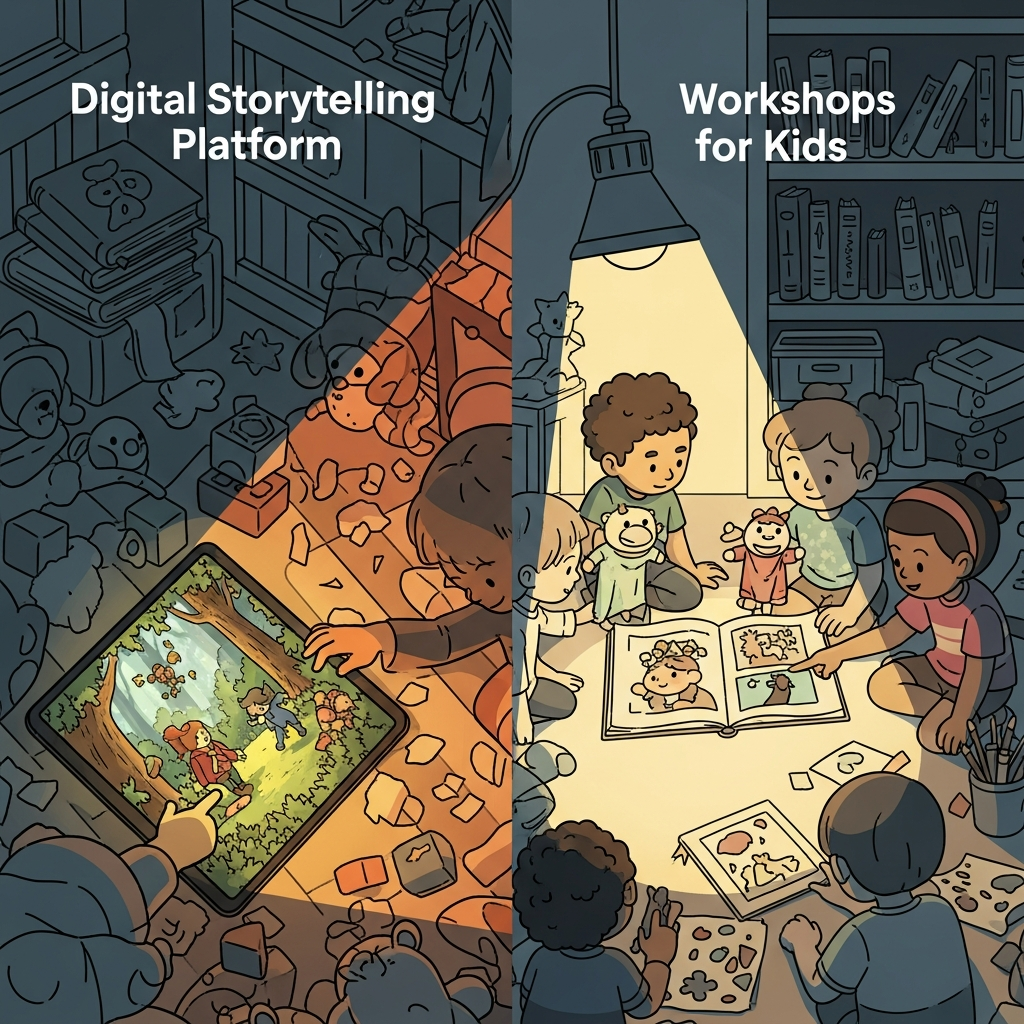
Comparing technology and human connection for bilingual children's cognitive development
Discover which storytelling approach best supports your child's language development. This honest comparison examines cognitive benefits, language availability, and emotional connection for heritage language preservation.
TL;DR
Digital platforms win on accessibility: Stories in 15+ languages, available anytime, with personalization that workshops cannot match
Workshops win on social learning: Community building and peer interaction have real value, but most heritage languages have no local workshop options
Research supports digital storytelling: Studies show significant cognitive benefits including improved observation, memory retention, and language development
For most multilingual families, start with digital: Daily consistent exposure matters more than occasional perfect experiences, especially when workshops in your language don't exist
Neither replaces you: Stories support heritage preservation but cannot substitute for speaking your language at home daily
The Choice Every Bilingual Parent Faces
Du stehst vor einer Entscheidung, die viele Eltern kennen. Your child needs stories. Stories that carry your language, your memories, the rhythm of your grandmother's voice.
But where do those stories come from? A digital storytelling platform that creates personalized tales on demand? Or storytelling workshops where real humans gather, breathe, and share?
This comparison examines both paths honestly. We'll look at cognitive benefits of storytelling through each approach, weighing what research reveals against what your heart already knows. Because for bilingual families preserving heritage language, the stakes feel higher than a simple app-versus-class decision.
The Quick Verdict
Choose a digital storytelling platform if you need consistent, daily exposure in your heritage language, especially when local workshops in your language simply don't exist.
Choose storytelling workshops if you have access to groups in your target language and your child thrives on social interaction and live performance energy.
The truth? Most multilingual families benefit from both. But if forced to choose one starting point, digital platforms offer something workshops cannot: availability in over 15 languages, on your schedule, with your child as the hero.
Criterion | Digital Platforms | Traditional Workshops | Better For |
|---|---|---|---|
Language Availability | 15+ languages on demand | Limited to local offerings | Digital |
Personalization | Child's name, culture, interests | Generic group content | Digital |
Social Interaction | Limited | Rich peer engagement | Workshops |
Consistency | Daily access possible | Weekly at best | Digital |
Emotional Connection | Strong (personalized) | Strong (live presence) | Tie |
Cost Over Time | Subscription-based | Per-session fees add up | Varies |
Cognitive Skill Building | Research-backed gains | Proven but less studied | Digital (evidence) |
What We're Actually Comparing
Before diving deeper, let's define our criteria. These seven dimensions matter most for families balancing heritage preservation with practical constraints.
Language Access and Availability
Can you actually find content in your language? This is the foundation everything else builds upon.
Personalization Depth
Does the story speak to your child specifically, or to children generally?
Cognitive Development Impact
What does research say about memory, language acquisition, and critical thinking?
Emotional Resonance
Does your child feel seen, connected, moved?
Practical Accessibility
Can you actually use this consistently given your life?
Social Learning Opportunities
Does your child learn alongside others?
Cultural Authenticity
Does the content genuinely reflect your heritage, or just translate German stories?
Head-to-Head: Where Each Approach Shines
Language Access and Availability
Digital Platforms: This is where technology transforms possibility. A platform like StoryAtlas offers stories in over 15 languages instantly. Whether you speak Turkish, Vietnamese, Arabic, or Polish, content exists. No waiting for a workshop to open. No hoping enough families share your language.
Storytelling Workshops: In major German cities, you might find German-language workshops easily. Perhaps English or Spanish. But Tagalog? Urdu? Tamil? The reality is harsh: most heritage languages have no local workshop options at all.
Verdict: Digital platforms win decisively for multilingual families. Workshops simply cannot compete on language diversity.
Cognitive Development Impact
Digital Platforms: Research increasingly supports digital storytelling's cognitive benefits. A study of 238 children found that those exposed to digital storytelling showed significant improvements in observation, classification, and prediction skills compared to control groups.
According to recent research on digital storytelling, children demonstrated enhanced narrative skills, expressive vocabulary, and communication abilities. Memory retention improved through multimedia-rich experiences that engage multiple brain areas simultaneously.
Storytelling Workshops: Live storytelling has ancient roots and intuitive appeal. Children learn through social modeling, watching how a storyteller uses voice, gesture, pause. However, comparative research on workshops specifically is surprisingly limited.
Verdict: Digital platforms have stronger research backing. This doesn't mean workshops are ineffective, just less studied in controlled settings.
Personalization and Emotional Connection
Digital Platforms: When your child hears their own name in a story, something shifts. They become the hero. AI-driven platforms can weave in cultural details, family traditions, even specific interests. This personalization creates what researchers call "self-referential processing," deepening engagement and memory.
Storytelling Workshops: A skilled storyteller reads the room. They notice a shy child and draw them in gently. They feel when energy drops and shift pace. This responsiveness is genuine magic that algorithms cannot replicate.
Verdict: Different strengths. Digital excels at personalized content; workshops excel at responsive delivery. For heritage language preservation specifically, hearing your name in your grandmother's tongue carries profound weight.
Practical Accessibility
Digital Platforms: Stories available at 6am when your child wakes early. At 8pm during bedtime routine. On vacation. During sick days. Consistency matters enormously for language acquisition, and digital platforms enable daily exposure that workshops cannot match.
Storytelling Workshops: Weekly sessions, if you're lucky. Fixed times that may conflict with work, naps, or siblings' schedules. Travel required. Cancellations happen. For busy families, attendance becomes another source of guilt.
Verdict: Digital platforms win on accessibility. Life with young children is unpredictable; technology adapts.
Social Learning and Community
Digital Platforms: This is the honest limitation. Your child listens alone (or with you). They don't see other children react, laugh, gasp. They miss the community building that happens when families gather around shared narratives.
Storytelling Workshops: Children learn that stories belong to groups, not just individuals. They practice listening alongside peers. For immigrant families, workshops can connect you with others sharing your language journey. These intergenerational narratives create bonds beyond the stories themselves.
Verdict: Workshops win clearly here. Social learning has value that technology cannot fully replicate.
Cultural Authenticity
Digital Platforms: Quality varies dramatically. Some platforms simply translate Western stories, losing cultural nuance. Others, like StoryAtlas, are built specifically for heritage preservation, creating culturally relevant content rather than adapted translations. The difference matters.
Storytelling Workshops: When led by native speakers from your culture, workshops can offer deep authenticity. But availability is the problem again. A workshop in "Spanish" might reflect Mexican traditions when your family is Argentine. Regional and cultural specificity often gets lost in generalized offerings.
Verdict: Depends entirely on the specific platform or workshop. Neither category wins automatically.
When Each Approach Works Best
Choose Digital Storytelling If:
Your heritage language has no local workshop options (most languages)
Your schedule makes consistent weekly attendance impossible
Your child responds strongly to personalized content
You need daily language exposure to build fluency
You want stories that reflect your specific cultural background, not generalized translations
Choose Traditional Workshops If:
Workshops exist in your target language locally
Your child is highly social and learns best in groups
You want to build community with other families on similar journeys
You have consistent schedule flexibility
Your child is over 3 and ready for group learning environments
Consider Both If:
You can find workshops in your language and want to supplement with daily digital exposure
You want social learning plus personalized heritage content
Different children in your family have different needs
What Neither Approach Solves
Honesty matters here. Both digital platforms and workshops face limitations that families should understand.
Neither replaces you speaking your heritage language daily at home. Stories support language learning but cannot substitute for live conversation with parents and grandparents.
Neither guarantees your child will embrace their heritage. Identity formation is complex; stories are one thread, not the whole fabric.
Neither fully addresses the "transfer deficit" that researchers like Kirkorian have identified, where very young children (especially under 2) learn less from screens than real-life interactions. Repeated exposure and well-designed content help, but this gap exists.
Switching and Combining: Practical Considerations
Starting with digital platforms involves minimal commitment. Most offer free trials or low monthly costs. You can begin tonight.
Workshops require more investment upfront: finding options, adjusting schedules, committing to a term. But they're also easy to pause or stop.
Many families find a rhythm: digital stories for daily heritage language exposure, occasional workshops when available for social connection. There's no lock-in with either approach.
If you've tried workshops and found them unavailable in your language, digital platforms solve that specific problem immediately. If you've used apps but miss community, seek out local cultural organizations that might host storytelling in education events.
The real question isn't "which is better" but "what combination serves my family's actual circumstances?"
The Recommendation for Bilingual Families in Germany
For most multilingual families, digital storytelling platforms should be your foundation. The math is simple: consistent daily exposure in your heritage language matters more than occasional perfect experiences. And for most languages, workshops simply don't exist locally.
A platform like StoryAtlas addresses what the Tonies catalog cannot: stories in your language, featuring your child, reflecting your culture. This isn't about technology being superior to human connection. It's about technology making heritage preservation possible when other options don't exist.
If you're fortunate enough to have workshop access in your language, add it. Let your child experience stories as community events, not just bedtime rituals. Both matter.
But start somewhere. Tonight. Your child's relationship with your language is being shaped now, in these early years. The stories you choose, in whatever form, become part of who they understand themselves to be.
Every child deserves to feel like the hero of their own story. In their own language. With their own name.
Frequently Asked Questions
What is multilingual storytelling?
Multilingual storytelling means sharing stories in multiple languages, often within the same family or community. For bilingual families, this typically involves stories in both the local language (German, for example) and the heritage language (Turkish, Vietnamese, Arabic, or others). The goal is preserving language skills and cultural connection across generations.
Why is multilingual storytelling important for cultural connection?
Stories carry more than words. They hold values, humor, rhythms of speech, and ways of seeing the world. When children hear stories in their heritage language, they absorb cultural knowledge alongside vocabulary. This creates emotional bonds through stories that facts and lessons cannot replicate.
How can storytelling in multiple languages enhance language learning?
Research shows that narrative context helps children retain vocabulary better than isolated word learning. Stories provide meaningful repetition, emotional engagement, and contextual clues that support comprehension. Studies confirm that digital storytelling improves vocabulary acquisition, comprehension, and oral fluency in young children.
At what age should I start using storytelling for heritage language preservation?
Begin as early as possible, understanding that very young children (under 2) learn more from live interaction than screens. For toddlers, combine digital stories with your own voice and presence. By ages 3-7, children can engage more independently with digital storytelling platforms while still benefiting from shared listening with parents.
Which techniques are effective for creating multilingual stories?
Effective multilingual storytelling includes personalization (using the child's name), cultural authenticity (reflecting real traditions rather than translated Western content), multimedia elements (combining audio, music, and imagery), and repetition patterns that support language acquisition naturally.
How does digital storytelling compare to reading bilingual children's books?
Both have value. Digital platforms offer audio in native speaker voices (important when parents feel less confident in heritage language pronunciation), personalization, and instant availability. Physical bilingual children's books offer tactile engagement and parent-child bonding through shared reading. Many families use both.