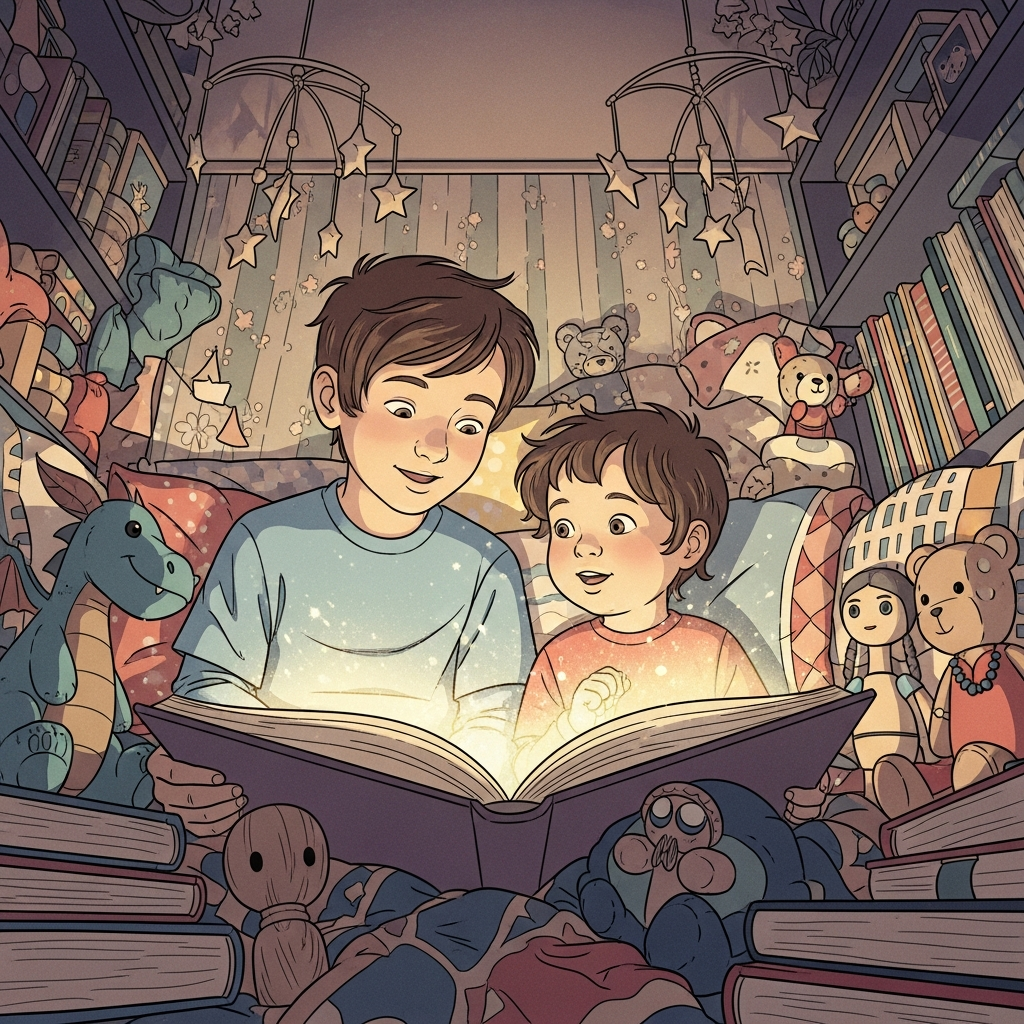
A guide for bilingual parents using narrative to build lasting cultural connection with their children
Learn why storytelling works differently than other forms of cultural transmission. Discover how to use narrative to create deep emotional bonds and preserve heritage in your bilingual family.
TL;DR
Stories create belonging, not just exposure - Your child needs to feel your culture emotionally, not just know facts about it. Authentic details and personal reflection make the difference.
Personalization transforms connection - When your child is the hero of a story rooted in their heritage, cultural identity becomes adventure rather than obligation.
Ritual matters as much as content - Consistent, predictable storytelling practices create emotional safety and signal that heritage is important enough to protect.
Heritage language carries what translation cannot - Stories in your mother tongue transmit worldview, humor, and ways of being that exist only in that language.
Let your child make the culture theirs - The goal is not perfect preservation but living transmission. When your child remixes your stories with their own life, culture stays alive.
What This Guide Covers
This guide explores how storytelling creates deep emotional bonds through stories in multicultural families. It is written for bilingual parents raising children between two cultures, two languages, two worlds.
By the end, you will understand why stories work differently than other forms of cultural transmission. You will learn how to use narrative to build lasting cultural connection with your child. And you will have a practical framework for making storytelling a cornerstone of your family's heritage preservation.
This guide focuses on emotional resonance and identity formation. It does not cover language acquisition techniques or educational curricula. The goal is depth of connection, not breadth of content.
Why Stories Matter More Than Ever
Something shifted in parenting. 90% of today's parents emphasize respect for cultural differences with their children. This is not a trend. It is a recognition that identity matters.
Yet here is the challenge you face. You live in Germany, but your heart holds another language. Your child hears German everywhere. At kindergarten. On the playground. In cartoons. Your heritage language becomes the quieter voice.
Generic content cannot solve this. Another translated fairy tale will not make your child feel seen. What creates belonging is specificity. A story where the hero has your child's name. Where the grandmother speaks like your grandmother spoke. Where the food, the landscapes, the small details feel like home.
78% of parents want their children exposed to more cultural diversity than they experienced growing up. The question is not whether to preserve culture. It is how to make that preservation feel like magic instead of homework.
Understanding Emotional Bonds Through Stories
Why Stories Work Differently
Stories bypass resistance. When you tell a child "this is your culture," they may or may not care. When you tell them a story where someone like them goes on an adventure, they lean in. They absorb without knowing they are absorbing.
This is not manipulation. It is how humans have always transmitted values. Through narrative. Through characters who model ways of being. Through emotional journeys that mirror our own.
The Difference Between Exposure and Belonging
Many parents confuse cultural exposure with cultural connection. Exposure means your child knows facts about their heritage. Connection means they feel it in their bones.
Exposure says: "We come from Turkey." Connection says: "Remember how the hero in your story found courage at the bazaar, just like the one your grandmother visited?"
Research on ethnic-racial socialization shows that Black and Latiné parents who share stories aligned with familism and cultural values help their children develop stronger emotional health. The mechanism is not information transfer. It is identity anchoring.
Community Building Through Shared Narratives
87% of parents state that shared experiences strengthen family bonds. Stories create those shared experiences. When you and your child know the same characters, you have a private language. References. Inside jokes. A world that belongs only to your family.
The Story Bond Framework
Building emotional bonds through stories follows a natural progression. Think of it as four interconnected phases: Root, Reflect, Ritualize, and Release.
Root means grounding stories in specific cultural details that feel authentic. Reflect means ensuring your child sees themselves in the narrative. Ritualize means making storytelling a predictable, cherished practice. Release means letting your child carry these stories forward in their own way.
Each phase builds on the previous. Skip one, and the connection weakens. Honor all four, and stories become part of who your child is.
Step-by-Step: Creating Lasting Story Bonds
Step 1: Root Stories in Authentic Detail
Objective: Make stories feel true to your heritage, not like generic translations.
The details matter more than the plot. A story set "somewhere far away" creates distance. A story set in a specific neighborhood, with specific foods, with the rhythm of your actual language creates recognition.
Start by identifying the sensory memories of your own childhood. What did your grandmother's kitchen smell like? What sounds filled the streets during holidays? What phrases did adults use that children found funny?
These details become the texture of your stories. They signal to your child: this is real. This is ours.
What to avoid: Sanitizing cultural elements to make them more "universal." The specific is what creates connection. Also avoid stereotypes or tourist-level representations of your own culture.
Success indicator: Your child asks questions about the details. "Did you really eat that?" "Is that place real?" Curiosity means the story landed.
Step 2: Reflect Your Child in the Narrative
Objective: Help your child see themselves as the hero of their own cultural story.
There is a reason 51% of children's books received by the CCBC in 2024 now feature significant BIPOC content. Representation matters. But general representation is not the same as personal reflection.
Your child needs to see not just "someone who looks like them" but someone who feels like them. This means stories that use your child's name. That reference their specific interests. That acknowledge the particular experience of living between cultures.
Personalized storytelling tools can help here. When a story's hero shares your child's name and heritage, the barrier between listener and character dissolves.
What to avoid: Making your child the passive recipient of culture. In stories, they should be agents. They should solve problems, make choices, show courage.
Success indicator: Your child refers to the story character as "me" or retells the story with themselves explicitly as the hero.
Step 3: Ritualize the Storytelling Practice
Objective: Transform storytelling from occasional activity to sacred family practice.
92% of parents prioritize emotional well-being in children. Rituals create emotional safety. They give children something to count on, something that anchors their week.
Choose a consistent time. Maybe Sunday mornings. Maybe the drive to school on Fridays. Maybe every night before bed in your heritage language only. The predictability matters as much as the content.
Create physical anchors for the ritual. A special blanket. A particular spot on the couch. A candle lit only during story time. These sensory cues tell your child's nervous system: something important is happening.
What to avoid: Making storytelling feel like a chore or obligation. If you are exhausted and resentful, your child will feel it. Better to have a shorter, joyful ritual than a longer, forced one.
Success indicator: Your child reminds you when story time is approaching. They protect the ritual.
Step 4: Layer Language Naturally
Objective: Use stories to make your heritage language feel alive and necessary.
88% of parents believe children should learn about their cultural heritage. Language is the deepest layer of that heritage. It carries rhythms, humor, and ways of seeing that cannot be translated.
Stories in your heritage language do not feel like language lessons. They feel like adventures. Your child absorbs vocabulary, grammar, and pronunciation without the resistance that comes from formal instruction.
Start where your child is. If they understand more than they speak, audio stories in your heritage language build comprehension. If they are more advanced, encourage them to retell stories in that language.
What to avoid: Correcting language mistakes during story time. This is bonding time, not instruction time. Save corrections for other moments.
Success indicator: Your child uses words or phrases from stories in everyday conversation. The language has migrated from story world to real world.
Step 5: Connect Stories to Living Family
Objective: Bridge fictional narratives to real intergenerational relationships.
The most powerful stories are not just about culture in the abstract. They connect to real people your child knows or knows of. Grandparents. Great-aunts. Ancestors whose names are still spoken.
After telling a story, draw the line: "Your great-grandmother was brave like that character. She came to a new country not knowing anyone." Suddenly the story is not fiction. It is family history.
If grandparents are available, involve them. A video call where grandmother tells a story in her own voice creates a memory that outlasts any book.
What to avoid: Idealizing ancestors to the point of unreality. Children can handle complexity. "Your grandfather was sometimes stubborn, but that same stubbornness helped him survive."
Success indicator: Your child asks about family members they have never met. They want to know more.
Step 6: Release the Story to Your Child
Objective: Allow your child to make the stories their own, even if they change them.
The final step requires letting go. Your child will not preserve your culture exactly as you received it. They will blend it with their German life, their own personality, their generation's concerns.
This is not loss. This is how culture stays alive. Encourage your child to retell stories in their own way. To add characters. To imagine sequels. To mix elements from different traditions.
When your child tells you a story that blends your heritage with their German reality, that is success. They are not abandoning your culture. They are making it theirs.
What to avoid: Policing their interpretations. Insisting on "correct" versions. Making them feel that their creative additions are wrong.
Success indicator: Your child creates their own stories using cultural elements you introduced. The torch has been passed.
Common Mistakes and How to Avoid Them
Treating stories as medicine. When cultural transmission feels like obligation, children resist. Stories should be gifts, not prescriptions.
Overwhelming with quantity. One deeply loved story does more than twenty forgotten ones. Depth over breadth.
Comparing to other families. Your neighbor's child might speak perfect heritage language. Yours might not. Each family's path is different. Comparison poisons the joy.
Waiting for the perfect moment.65% of parents actively seek resources to teach their children about different cultures. But seeking is not doing. Start imperfectly. Start today.
Forgetting that you are part of the story. Your voice, your presence, your attention during story time matters as much as the content. You are not just delivering culture. You are being culture.
What to Do Next
Tonight, tell your child one story. It does not need to be perfect. It does not need to be long. Just one story with one authentic detail from your heritage. Notice how they respond.
If you want stories that already carry your cultural specificity, that speak your language, that put your child's name at the center, explore what is possible with personalized audio stories designed for families like yours.
This is not about getting it right. It is about beginning. Every story you tell plants a seed. Some will grow in ways you expect. Some will surprise you. All of them matter.
Your child's relationship with their heritage will unfold over decades. What you build now, in these early years, becomes the foundation. Not through lectures. Not through obligation. Through stories that make them feel like the hero they already are.
Frequently Asked Questions
What is multilingual storytelling?
Multilingual storytelling means sharing narratives in more than one language, often weaving heritage languages with the dominant language of your environment. For families in Germany, this might mean telling stories in Turkish, Arabic, Polish, or any of the languages that represent home. The power lies not in translation but in authenticity, allowing each language to carry its own emotional weight and cultural nuance.
Why is multilingual storytelling important for cultural connection?
Language carries culture in ways that translation cannot capture. Jokes, rhythms, expressions of love, and ways of seeing the world live inside specific languages. When your child hears stories in your heritage language, they absorb not just vocabulary but worldview. This creates emotional bonds through stories that feel different from learning culture as information.
How can storytelling in multiple languages enhance language learning?
Stories remove the pressure of formal instruction. Your child is not "studying" when they listen to an adventure. They are engaged, curious, wanting to know what happens next. This emotional engagement helps vocabulary stick. Research shows that language learned in meaningful contexts transfers better to real-world use than language learned through drills.
When should I start telling heritage language stories to my child?
As early as possible, but it is never too late. Infants benefit from hearing the sounds and rhythms of your heritage language. Toddlers begin connecting words to meaning. Children aged 2 to 7 are in a prime window for language absorption. But even older children who have heard mostly German can develop deep connections to heritage stories when they feel emotionally relevant.
How does personalized storytelling differ from traditional children's books?
Traditional books offer general representation. Personalized stories offer specific reflection. When your child hears their own name as the hero, when the story references their actual heritage, the distance between listener and character collapses. This is not vanity. It is identity formation. Your child learns that stories can be about people exactly like them.
What if I am not a good storyteller?
You do not need to be a performer. Your child wants your presence, not perfection. A simple story told with warmth matters more than an elaborate tale told with anxiety. Start with memories from your own childhood. Or use audio stories in your heritage language and listen together, pausing to talk about what you hear.