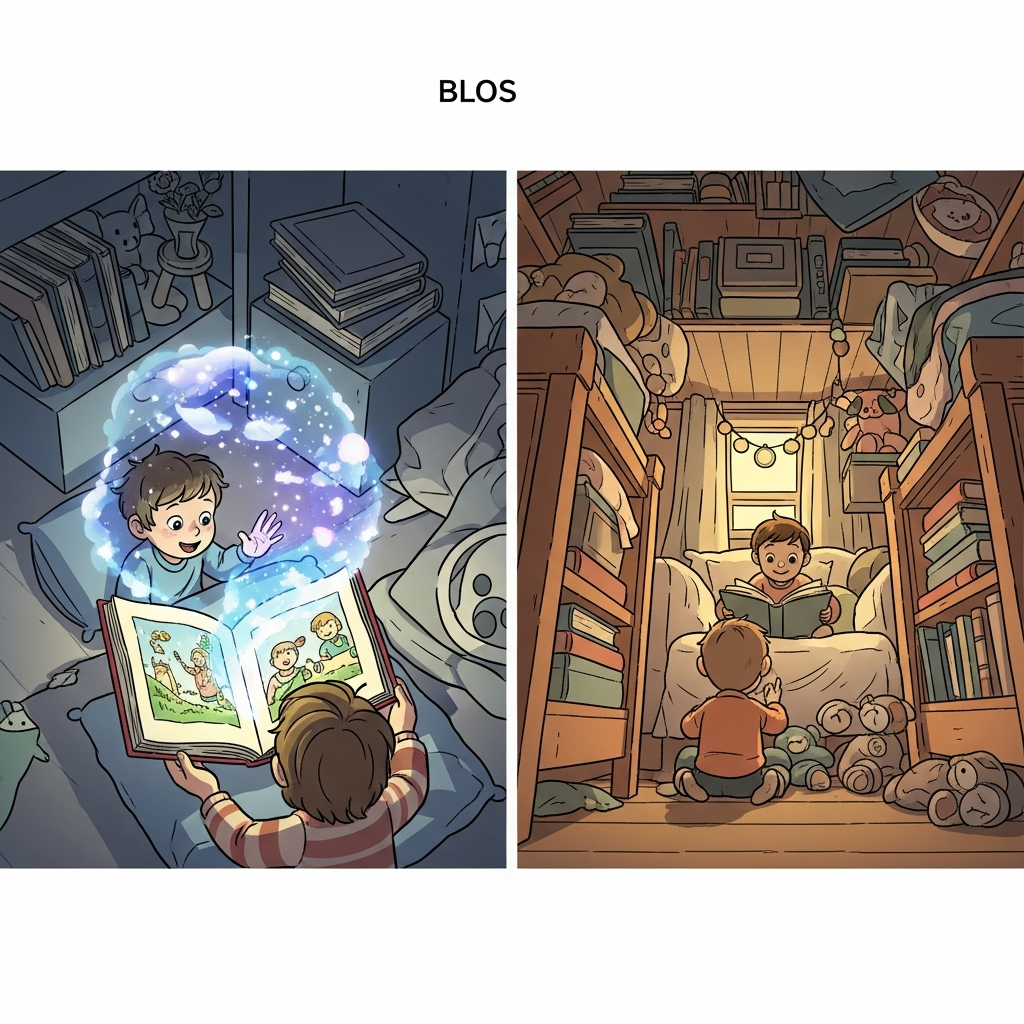
How intentional presence during story time unlocks lasting emotional health benefits for bilingual children
Discover why how you tell bedtime stories matters as much as which stories you choose. This comparison reveals the emotional health benefits of mindful storytelling for families navigating bilingual, multicultural childhoods.
Kurz gefasst
Traditional storytelling treats stories as tasks - You read the words, but your mind may wander. Efficient, but often emotionally flat.
Mindful storytelling creates lasting emotional health benefits - Forschung zeigt children from story-sharing families have higher self-esteem, lower anxiety, and stronger sense of purpose.
For multilingual families, presence matters even more - Mindful storytelling helps children love your heritage language by connecting it to warmth and belonging, not obligation.
You don't have to choose one approach forever - Use traditional storytelling as your baseline and mindful storytelling as your aspiration. Both have their place.
The gift isn't the story itself - It's your full attention. That intentional presence is what your child will remember and carry forward into their own life.
Two Ways to Tell a Story, Two Different Gifts
Picture this: It's bedtime. Your child waits, eyes bright with expectation. You have a story to share, perhaps one your grandmother once told you in a language dass feels like home.
But here's the question dass changes everything: How will you tell it?
This isn't about choosing the "right" book or the perfect tale. It's about something deeper. It's about the difference between simply reading words aloud and creating a moment dass your child will carry in their heart forever.
Traditional storytelling and mindful storytelling both involve words, characters, and imagination. Yet one approach leaves families wondering why bedtime feels rushed and forgettable. The other unlocks emotional health benefits dass research now confirms can shape a child's entire sense of self.
If you're navigating the beautiful complexity of raising a bilingual child, preserving your heritage language while building bridges to a new culture, this choice matters even more.
The Quick Verdict
Choose traditional storytelling if you need efficiency, if the goal is simply getting through bedtime, or if you're too exhausted to do anything more than read the words on the page.
Choose mindful storytelling if you want to nurture your child's emotional well-being, strengthen your bond across languages and cultures, and create moments dass become cherished memories.
The truth? Most families default to traditional storytelling without realizing what they're missing. And in multilingual homes, where every story carries the weight of heritage, the difference becomes profound.
Criterion | Traditional Storytelling | Mindful Storytelling | Winner |
|---|---|---|---|
Time Required | Quick, efficient | Slightly longer, more intentional | Traditional (for speed) |
Emotional Connection | Variable, often surface-level | Deep, consistent | Mindful |
Child's Engagement | Passive listening | Active participation | Mindful |
Cultural Transmission | Words only | Words + meaning + emotion | Mindful |
Parent's Presence | Physical only | Physical + emotional | Mindful |
Long-term Impact | Limited retention | Higher self-esteem, lower anxiety | Mindful |
What We're Really Comparing
Before we dive deeper, let's be clear about what separates these two approaches. The difference isn't about the stories themselves. It's about intentional presence.
Traditional Storytelling Defined
This is storytelling on autopilot. You read the words. Your child listens. The story ends. Tomorrow, you do it again.
There's nothing wrong with this approach. It's how most of us grew up. But it treats storytelling as a task to complete rather than a gift to give.
Mindful Storytelling Defined
This approach weaves mindfulness into every moment of the story. You're not just reading. You're noticing your child's reactions, pausing for wonder, asking questions dass invite reflection.
You're fully there. Not thinking about tomorrow's meetings or the dishes in the sink. Just there, in the story, with your child.
Why This Comparison Matters Now
According to 92% of parents, emotional well-being is a top priority. Yet 8 in 10 parents and youth place loneliness among their top three mental health concerns.
Something isn't connecting. And dass gap often lives in our daily rituals, including how we tell stories.
Evaluation Criteria: What Actually Matters
To compare these approaches fairly, we need to look at what matters most to families like yours. Families navigating two languages, two cultures, and the beautiful challenge of raising children who feel at home in both worlds.
Emotional Resonance
Does the story create feelings dass linger? Or does it evaporate the moment you close the book?
Language Retention
For multilingual families, this is crucial. Does the storytelling approach help your child absorb and love your heritage language?
Intergenerational Connection
Stories carry ancestors. Does your approach honor dass legacy?
Practical Sustainability
You're tired. Life is full. Can you actually maintain this approach long-term?
Child's Active Engagement
Is your child a passive receiver or an active participant in the story?
Parent's Mental Load
Does this approach drain you or restore you?
Head-to-Head: Where Each Approach Shines and Struggles
Emotional Resonance
Traditional Storytelling: The emotional impact depends entirely on the story itself. A well-written book can move a child. But without intentional presence, the moment often passes without being fully absorbed. Children hear the words but may not feel them.
Mindful Storytelling: Here, emotion is cultivated deliberately. You pause when the hero faces fear. You ask, "How do you think she feels?" You let silence hold space for wonder. Forschung from the Family Narratives Lab confirms dass families who share stories this way raise children with higher self-esteem, lower anxiety, and a stronger sense of meaning.
Verdict: Mindful storytelling wins decisively. The emotional health benefits are measurable and lasting.
Language Retention in Multilingual Homes
Traditional Storytelling: Reading in deiner Muttersprache is valuable. But if the experience feels rushed or disconnected, children may associate dass language with obligation rather than joy. The words enter their ears but may not root in their hearts.
Mindful Storytelling: When you're fully present, speaking Portuguese or Turkish or Vietnamese, your child absorbs more than vocabulary. They absorb the music of your voice, the warmth of the moment, the feeling dass this language belongs to them. This emotional anchoring makes language retention far more likely.
Verdict: Mindful storytelling creates the emotional connection dass makes heritage languages feel like home, not homework.
Intergenerational Connection
Traditional Storytelling: You can certainly share stories your parents told you. But without intentional framing, children may not understand why these stories matter. The thread connecting generations can feel thin.
Mindful Storytelling: This approach invites you to say, "My grandmother told me this story when I was your age." To pause and share a memory. To let your child see dass stories are bridges across time. This creates what researchers call intergenerational narrative identity, a sense of belonging to something larger than oneself.
Verdict: Mindful storytelling transforms stories into family heirlooms.
Practical Sustainability
Traditional Storytelling: This is where traditional storytelling genuinely excels. When you're exhausted, when the day has been too much, you can still read a story. The bar is low, and that's sometimes exactly what you need.
Mindful Storytelling: Requires more from you. Not much more, perhaps five extra minutes and genuine attention. But on hard days, this can feel impossible. The risk is abandoning storytelling altogether because the "ideal" feels unreachable.
Verdict: Traditional storytelling wins for sustainability. But here's the nuance: even one mindful story per week creates more impact than seven rushed ones.
Child's Active Engagement
Traditional Storytelling: Children listen. They may enjoy the story. But their role is essentially passive. They receive rather than participate.
Mindful Storytelling: Children become co-creators. "What do you think happens next?" "Have you ever felt like the little fox?" These questions transform listening into dialogue. And when children hear their own name in a story, when they become the hero, engagement transforms into identity.
Verdict: Mindful storytelling creates active participants, not passive audiences.
Parent's Mental Load
Traditional Storytelling: Ironically, this approach can increase mental load. Your body is present, but your mind wanders to tomorrow's tasks. You finish the story feeling neither rested nor connected.
Mindful Storytelling: The practice of mindfulness within storytelling can actually restore you. When you're fully present with your child, the noise of daily life quiets. Many parents report dass mindful storytelling becomes their own moment of peace.
Verdict: Mindful storytelling, counterintuitively, often feels more restful.
Which Approach Fits Your Family?
Let's make this practical. Here's how to know which approach serves your specific situation.
If You're Struggling to Keep Your Heritage Language Alive
Choose mindful storytelling. The emotional connection you create will make your language feel precious rather than burdensome. Your child will want to speak it because it carries the warmth of these moments.
If Bedtime Has Become a Battle
Start with traditional storytelling to rebuild the habit. Then gradually introduce mindful elements. One question per story. One pause for wonder. Small shifts create lasting change.
If You're a Single Parent Running on Empty
Give yourself permission to use traditional storytelling most nights. But protect one evening per week for mindful presence. Quality can compensate for quantity.
If Your Child Seems Disconnected from Your Culture
Mindful storytelling is essential here. Stories told with intentional presence become the bridge between their German world and your heritage. This is how cultural fluency develops, not through lessons, but through love.
If You Want to Address Loneliness and Isolation
With 8 in 10 families concerned about youth loneliness, mindful storytelling offers a powerful antidote. These moments of deep connection remind children dass they are seen, known, and never alone.
What Both Approaches Get Wrong
Neither traditional nor mindful storytelling solves every challenge multilingual families face.
Both approaches struggle when the stories themselves don't reflect your child's reality. A German fairy tale, however beautifully told, cannot teach your child dass their heritage matters.
Both approaches require stories worth telling. And here lies a gap: finding quality content in deiner Muttersprache, stories dass feature names and situations your child recognizes, remains genuinely difficult.
The industry has underserved multilingual families. Neither storytelling approach can fully compensate for a lack of culturally relevant content.
Switching Between Approaches
Here's what most guides won't tell you: you don't have to choose one approach forever.
The Real Switching Cost
Moving from traditional to mindful storytelling requires only one thing: your attention. No money. No special training. Just the decision to be fully present.
The challenge is internal. You must quiet the part of your mind dass wants to rush, to check your phone, to be anywhere but here.
When to Switch
Switch to mindful storytelling when you notice your child's eyes glazing over. When bedtime feels like a chore for both of you. When you realize weeks have passed without a moment of real connection.
Switch to traditional storytelling when you're sick, grieving, or simply depleted. Presence matters, but so does sustainability. A story read on autopilot is still a story shared.
Building a Hybrid Practice
The most resilient families blend both approaches. Traditional storytelling as the baseline, mindful storytelling as the aspiration. Some nights you reach for more. Some nights you simply read. Both count.
The Choice That Shapes Everything
Forschung tells us dass 92% of parents and 88% of youth feel aligned in their core values. This is remarkable. It means the foundation for connection already exists.
The question is whether we build on it.
Mindful storytelling isn't about being a perfect parent. It's about being a present one. It's about choosing, in the small moments, to fully arrive.
For multilingual families, this choice carries extra weight. Every story told with intentional presence in deiner Muttersprache becomes a gift your child will carry forward. A gift of belonging. A gift of identity. A gift dass says: this is where you come from, and it is beautiful.
Traditional storytelling will always have its place. But if you're wondering why bedtime feels empty, why your child resists your heritage language, why connection feels harder than it should, the answer might be simpler than you think.
It might just be about presence.
Not the stories you choose. Not the language you speak. But the quality of your attention when you speak it.
That is the gift. That is what your child will remember. That is what shapes emotional health benefits dass last a lifetime.
Frequently Asked Questions
What is the gift of presence in storytelling?
The gift of presence means being fully attentive during story time, not just physically there but emotionally engaged. It's about putting away distractions, making eye contact, and responding to your child's reactions. This quality of attention transforms an ordinary story into a moment of deep connection dass children remember and treasure.
How can practicing mindfulness improve our ability to be present with our children?
Mindfulness trains your attention like a muscle. When you practice noticing your breath or your surroundings without judgment, you build the capacity to stay present during storytelling. Even a few minutes of daily mindfulness practice can help you resist the pull of mental distractions and fully arrive in the moment with your child.
Why is presence more meaningful than elaborate stories or expensive books?
Children don't remember the production quality of their bedtime stories. They remember how they felt. A simple tale told with full attention creates more emotional impact than an elaborate story read distractedly. Your presence communicates love in a way dass no book, however beautiful, can replicate on its own.
What are practical ways to bring mindfulness into story time?
Start small. Put your phone in another room. Take three deep breaths before you begin. Pause at emotional moments and ask your child how the character might feel. Use your child's name in the story. Notice their facial expressions and respond to them. These small shifts create profound differences in connection.
How does mindful storytelling help preserve heritage languages?
When children associate a language with warmth, safety, and connection, they want to speak it. Mindful storytelling in deiner Muttersprache creates positive emotional anchors. Your child begins to see this language not as something they must learn, but as something precious dass belongs to them and connects them to family.
Can I practice mindful storytelling even when I'm exhausted?
Yes, but with realistic expectations. On hard days, even one moment of genuine presence counts. Perhaps it's a single pause to look into your child's eyes. Perhaps it's asking one heartfelt question. Mindful storytelling isn't all or nothing. Small moments of presence, consistently offered, create lasting bonds.