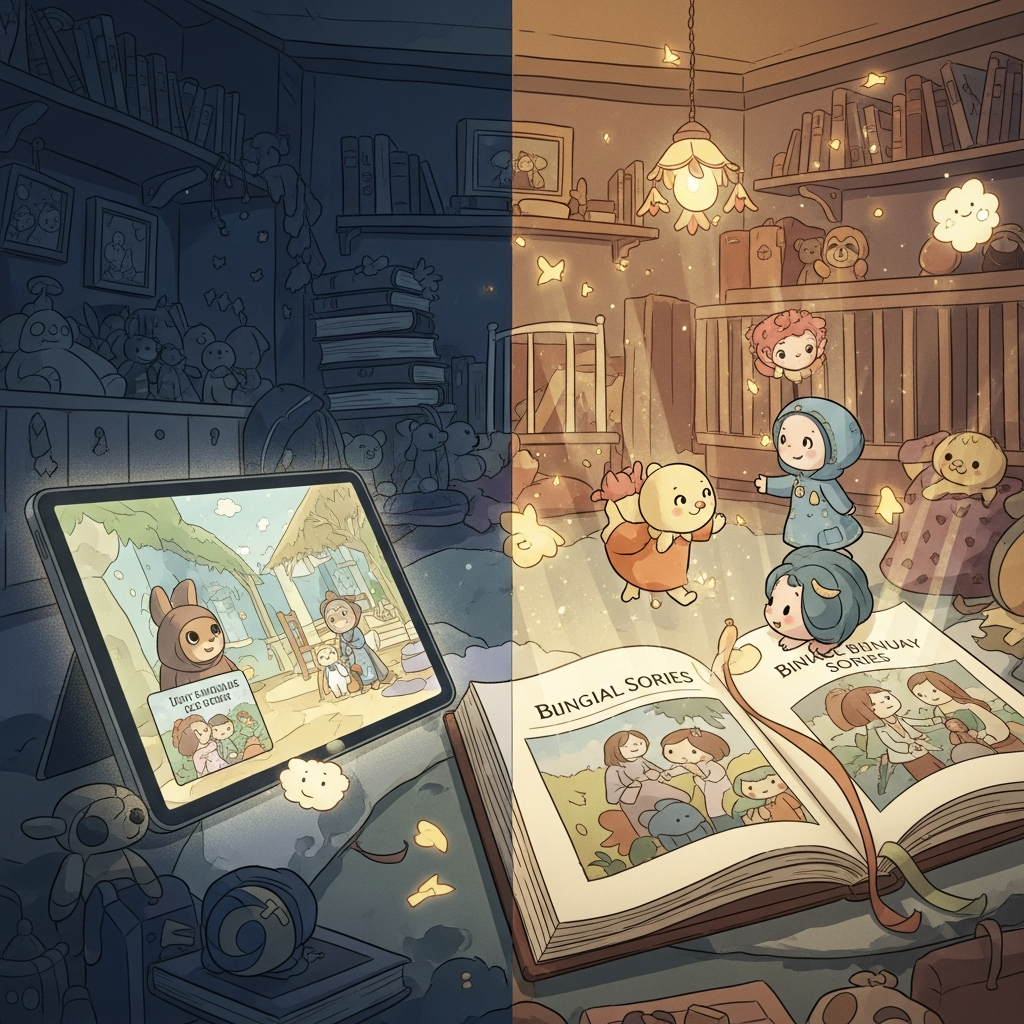
Why modern families are choosing personalized digital stories over traditional formats for heritage language preservation
Discover which format better serves your multilingual family. This comparison reveals how digital storytelling platforms offer broader language access and cultural personalization that traditional bilingual children's books cannot match.
TL;DR
Language availability is the deciding factor - Traditional bilingual books serve only major language pairs, while digital platforms like StoryAtlas offer 15+ languages including underserved communities.
Personalization transforms engagement - Digital platforms make your child the hero with their name and cultural details woven throughout, creating deeper emotional connection to heritage language content.
Traditional books win on tactile experience - Physical pages create rituals and heirlooms that screens cannot replicate, making them valuable for families who prioritize this dimension.
Consider a hybrid approach - Use digital platforms for daily language exposure and variety, supplemented by carefully chosen physical books for special moments.
For underserved languages, digital is the only real option - If traditional publishing has ignored your heritage language, digital storytelling platforms exist specifically to fill that gap.
The Decision Every Bilingual Family Faces
You stand in the children's section of your local bookstore. Your eyes scan the shelves for something, anything, in your mother tongue. Maybe you find one faded title. Maybe nothing at all.
This is the reality for multilingual families in Germany. The choice between traditional bilingual children's books and a modern digital storytelling platform isn't just about format. It's about whether your child will hear their name in a story that sounds like home.
This comparison examines what matters most: language availability, personalization, cultural authenticity, and the emotional connection that turns stories into heritage preservation.
Quick Verdict
Choose traditional bilingual children's books if you're working with major language pairs like German-English or German-French, and you value the tactile experience of physical pages above all else.
Choose a digital storytelling platform if your heritage language falls outside mainstream publishing, you want your child as the story's hero, or you need content that reflects your specific cultural traditions rather than generic translations.
For most immigrant families navigating heritage preservation, digital platforms offer what traditional publishing simply cannot provide.
Criterion | Traditional Bilingual Books | Digital Storytelling Platforms | Winner |
|---|---|---|---|
Language Availability | Limited to 5-10 major languages | 15+ languages including underserved communities | Digital |
Personalization | Generic characters and names | Child's name, cultural details woven throughout | Digital |
Cultural Authenticity | Often surface-level translations | Creative translation with cultural context | Digital |
Accessibility | Requires physical purchase, shipping | Instant delivery on any device | Digital |
Tactile Experience | Physical pages, bedtime ritual | Audio-focused, screen-based | Traditional |
Cost Over Time | Individual book purchases add up | Subscription model with unlimited stories | Digital |
What We're Measuring (And Why It Matters)
Language availability determines whether your heritage language exists in the format at all. For families speaking Tamil, Tagalog, or Turkish, this isn't a preference. It's a prerequisite.
Personalization depth affects whether your child sees themselves in the story. Research shows children engage more deeply when they recognize their own name and cultural markers in narratives.
Cultural authenticity separates creative translation from word-for-word conversion. Does the story capture how your grandmother actually told tales, or does it feel like a foreign text wearing your language's clothes?
Accessibility and convenience matter for busy families. Can you access content during a spontaneous car ride or only after waiting for international shipping?
Engagement and interactivity shape how children absorb language. Generation Alpha shows clear preference for immediacy, interactivity, and multimedia storytelling.
Head-to-Head: Language Availability
Traditional Bilingual Books
Publishing economics are unforgiving. Traditional bilingual children's books concentrate on profitable language pairs: German-English, German-French, German-Spanish. If your family speaks Vietnamese, Urdu, or Amharic, the shelves offer silence.
Even when books exist, they often represent a single dialect or regional variation. A Turkish family from the Black Sea region may find Istanbul Turkish that feels distant from their linguistic home.
Digital Storytelling Platforms
Digital platforms break free from print economics. StoryAtlas offers over 15 languages, specifically addressing gaps in existing content catalogs like Tonies. AI-driven content generation means adding new languages doesn't require massive upfront publishing investments.
The global market for bilingual reading platforms reached USD 1.28 billion in 2024, reflecting demand that traditional publishing has failed to meet.
Verdict
Digital wins decisively. If your language isn't German, English, French, or Spanish, traditional publishing has largely abandoned you. Digital platforms exist precisely because this gap needed filling.
Head-to-Head: Personalization
Traditional Bilingual Books
Traditional books offer fixed narratives. Your child meets characters named Emma or Max, living in settings that may feel foreign to your family's experience. Some publishers offer name-customization services, but these remain rare and expensive.
The stories themselves follow universal themes, which sounds inclusive but often means culturally neutral to the point of blandness.
Digital Storytelling Platforms
Digital platforms transform your child into the story's hero. Their name appears throughout. Cultural details from your heritage weave into the narrative. The story acknowledges who they actually are rather than asking them to imagine themselves as someone else.
Research on 202 children demonstrated that digital formats boosted engagement through interactivity, particularly when accompanied by adult participation.
Verdict
Digital wins clearly. Personalization isn't a luxury feature. For children navigating dual cultural identities, seeing themselves reflected in stories validates their place in both worlds.
Head-to-Head: Cultural Authenticity
Traditional Bilingual Books
Most bilingual children's books begin as English or German originals, then undergo translation. The result often feels like wearing borrowed clothes. Idioms land awkwardly. Cultural references don't translate. The rhythm of storytelling in your language gets flattened into the source text's patterns.
Creative translation, the art of capturing meaning and feeling rather than just words, requires skilled translators who understand both cultures deeply. Traditional publishing rarely invests in this level of care for smaller language markets.
Digital Storytelling Platforms
The best digital platforms approach multilingual storytelling differently. Rather than translating existing content, they generate stories with cultural context built in from the start. This enables narrative translation techniques that honor how stories actually flow in each language.
Library engagement studies confirm that digital storytelling leverages multimedia tools to enhance literacy beyond what static print can achieve.
Verdict
Digital wins with nuance. The best traditional bilingual books with careful creative translation can achieve cultural authenticity. But they're rare and expensive. Digital platforms make culturally sensitive storytelling accessible at scale.
Head-to-Head: Accessibility
Traditional Bilingual Books
Finding bilingual children's books in less common languages often means international shipping, specialty bookstores, or hoping relatives abroad can send copies. Availability is unpredictable. Prices climb quickly. Building a meaningful library takes years and significant investment.
Physical books also require storage space and aren't portable in the way modern families need.
Digital Storytelling Platforms
Digital formats on tablets and smartphones surpass static print in convenience. A story in your heritage language becomes available instantly, anywhere. Waiting rooms, car rides, grandparent video calls, all become opportunities for language learning.
Audio formats particularly shine for younger children who aren't yet reading, and for parents who may not read their heritage language fluently but want their children to hear it spoken correctly.
Verdict
Digital wins for practicality. The magic of bedtime stories shouldn't depend on international shipping schedules or whether your local library stocks Tamil picture books.
Head-to-Head: The Tactile Experience
Traditional Bilingual Books
Here, traditional books hold genuine advantage. The weight of pages. The ritual of turning them together. The worn spine of a beloved story read hundreds of times. These physical experiences create emotional bonds through stories that digital formats struggle to replicate.
For families building intergenerational narratives, physical books become heirlooms. Grandmother's handwriting in the margins. The coffee stain from that chaotic Tuesday. These marks tell their own stories.
Digital Storytelling Platforms
Digital platforms offer different rituals. The excitement of hearing your name in a new story. The ability to listen together during a long drive. The connection of sharing a story with grandparents across continents in real-time.
But screens remain screens. The tactile magic of physical books cannot be digitized.
Verdict
Traditional wins this dimension. Families who value physical books as objects of heritage preservation have legitimate reasons to prioritize print. The question is whether that value outweighs the limitations in language availability and personalization.
Use Case Mapping: Which Format Fits Your Family?
If your heritage language is widely published (English, French, Spanish, Mandarin), traditional bilingual children's books offer a viable path. You'll find options, though personalization remains limited.
If your heritage language is underserved by publishing (Turkish, Vietnamese, Tagalog, Arabic dialects, African languages), a digital storytelling platform is likely your only option for quality content.
If your child struggles to engage with stories featuring unfamiliar names and settings, digital personalization can transform their relationship with heritage language content.
If grandparents want to participate in storytime across distances, digital platforms enable shared narratives that physical books cannot.
If building a physical library is central to your family's identity, consider using digital platforms for daily engagement while curating a smaller collection of exceptional print books for special occasions.
What Both Formats Get Wrong
Neither traditional bilingual books nor most digital platforms fully solve the dialect problem. Your family's specific regional variation, the way your grandmother actually spoke, often gets standardized into a "proper" version of the language.
Both formats also struggle with code-switching, the natural way bilingual families actually talk, mixing languages within sentences. Stories tend to keep languages artificially separate.
And neither format can replace the irreplaceable: you, telling your own family folklore in your own voice. Technology and publishing support heritage preservation. They cannot substitute for it.
Switching Costs and Practical Considerations
Moving from traditional books to digital involves minimal friction. Your existing book collection remains valuable. Digital simply adds options you didn't have before.
The reverse transition is harder. If you've built your child's language learning around a digital platform's personalized stories, finding equivalent print content may prove impossible for less common languages.
Consider a hybrid approach: digital platforms for daily language exposure and variety, supplemented by carefully chosen physical books for the tactile rituals that matter to your family. Neither format demands exclusivity.
Subscription costs for digital platforms typically compare favorably to building a physical library, especially when accounting for shipping costs for imported books.
The Clear Recommendation
For most bilingual families in Germany navigating heritage preservation, digital storytelling platforms offer what traditional publishing cannot: your language, your child's name, your cultural context, available now.
Traditional bilingual children's books serve families working with major language pairs who prioritize physical format above all else. That's a valid choice, but it's a choice available only to those whose languages the market deems profitable.
For everyone else, for families speaking the languages traditional publishing ignores, digital platforms aren't just better. They're the only option that truly sees you.
Your child deserves to be the hero of stories that sound like home. The format that makes that possible is the right choice for your family.
Frequently Asked Questions
What is multilingual storytelling?
Multilingual storytelling involves creating and sharing narratives in multiple languages, honoring the natural way bilingual families communicate. It goes beyond simple translation to capture cultural nuances, idiomatic expressions, and the emotional rhythm of each language. For children, it means hearing stories that reflect their full identity rather than just one part of it.
Why is multilingual storytelling important for cultural connection?
Stories carry more than words. They transmit values, humor, and ways of seeing the world that define a culture. When children hear stories in their heritage language, they absorb these deeper layers alongside vocabulary. This creates emotional bonds to their cultural roots that textbook language learning cannot replicate.
How can storytelling in multiple languages enhance language learning?
Children learn language best through meaningful, emotionally engaging content. Stories provide context that makes vocabulary stick. When a child hears their own name in a story, engagement deepens further. The cognitive benefits of storytelling include improved memory retention, expanded vocabulary, and stronger comprehension skills across both languages.
At what age should children start with bilingual stories?
From birth. Children's brains are primed for language acquisition in the earliest years. Audio stories in heritage languages benefit even infants, establishing the sounds and rhythms of the language. By ages 2 to 7, children can engage more actively with narratives, making this the ideal window for personalized storytelling.
Can digital storytelling platforms replace reading physical books together?
They serve different purposes. Digital platforms excel at providing diverse, personalized content in underserved languages. Physical books offer tactile experiences and ritual. The healthiest approach combines both: digital for variety and language exposure, physical books for special shared moments. Neither needs to replace the other.
How do I know if a digital platform offers authentic cultural content?
Look for platforms that generate content with cultural context built in rather than simply translating existing stories. Check whether they offer creative translation that captures meaning and feeling, not just words. Read reviews from families who share your cultural background. The best platforms understand that heritage preservation requires more than language accuracy.
Sources
https://ijels.com/upload_document/issue_files/90IJELS-108202572-Interactive.pdf
https://growthmarketreports.com/report/bilingual-reading-platforms-for-kids-market
https://journals.sagepub.com/doi/abs/10.1177/25138502251371320
https://www.rgujournal.in/index.php/RGUJSSR/article/download/55/20
https://www.statista.com/outlook/amo/media/books/north-america