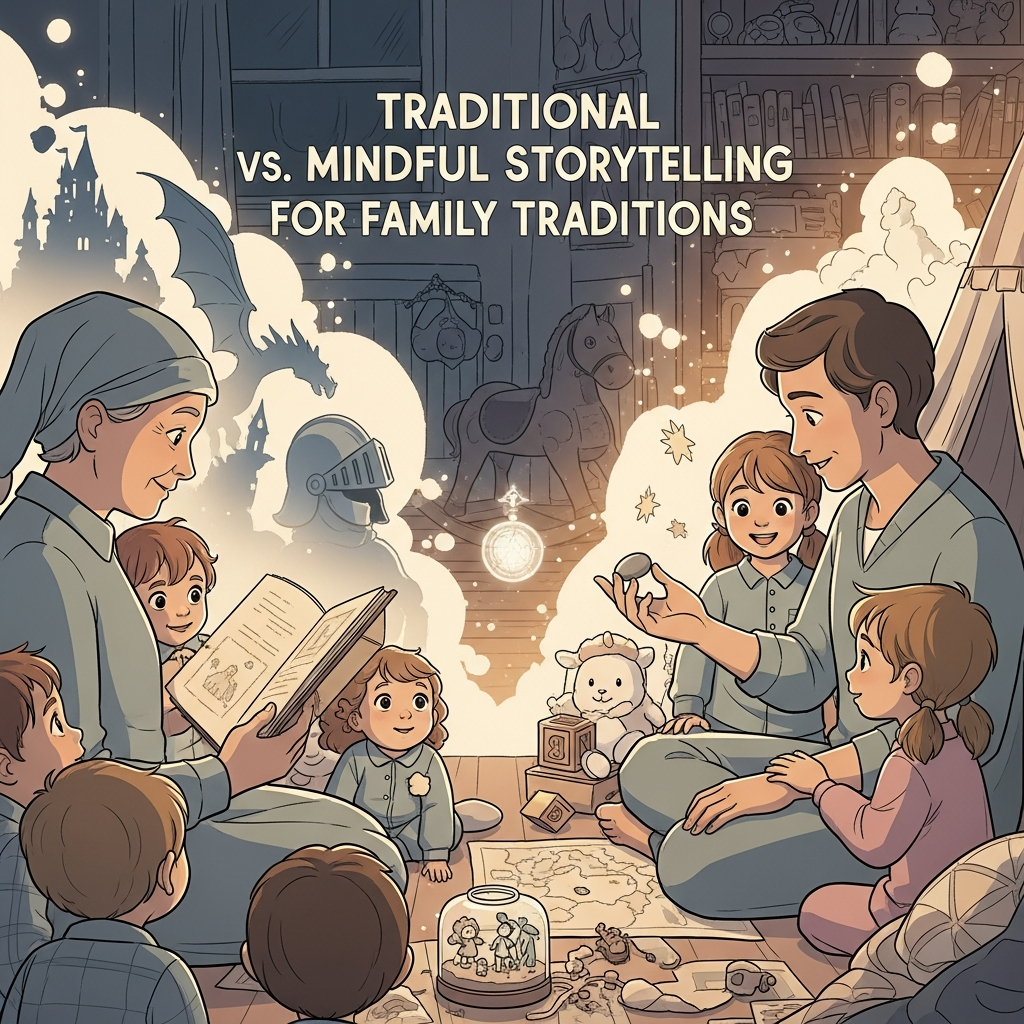
Wie zwei Ansätze für Gute-Nacht-Geschichten unterschiedliche Formen von Generationenverbindung in mehrsprachigen Familien schaffen
Entdecken Sie, welche Erzählmethode Familienbräuche in Ihrem mehrsprachigen Zuhause stärkt. Dieser Vergleich zeigt, wann traditionelle Narrationen am besten funktionieren und wann Achtsamkeit tiefere emotionale Bindungen über Generationen hinweg schafft.
TL;DR
Traditionelles Geschichtenerzählen zeichnet sich bei der Kulturübertragung aus und funktioniert gut, wenn die Zeit begrenzt ist oder Sie bestimmte Geschichten und Bräuche effizient weitergeben möchten.
Achtsamkeitsbasiertes Geschichtenerzählen schafft tiefere emotionale Bindungen und stärkere Generationenverbindungen, erfordert aber mehr Zeit und bewusste Präsenz.
Beide Ansätze bewahren die Herkunftssprache gleich gut, obwohl Achtsamkeit im Laufe der Zeit eine stärkere emotionale Bindung zur Sprache schaffen kann.
Der beste Ansatz kombiniert beide Methoden: traditionelle Geschichten für Wochentagseffizienz, achtsamkeitsbasierte Geschichten für Wochenendtiefe und gemischte Ansätze für besondere Familienmomente.
Ihre Präsenz ist wichtiger als die Methode: ein abgelenkter Elternteil, der jede Technik nutzt, verbindet sich weniger als ein präsenter Elternteil, der eine einfache Geschichte mit Wärme erzählt.
Zwei Wege, um weiterzugeben, was wichtig ist
Sie sitzen mit Ihrem Kind vor dem Schlafengehen. Eine Geschichte wartet darauf, erzählt zu werden. Aber welche Art von Geschichte? Und wie erzählen Sie sie?
Für mehrsprachige Familien in Deutschland trägt dieser Moment Gewicht. Sie unterhalten nicht nur. Sie bauen Brücken zwischen Welten, zwischen Sprachen, zwischen Generationen.
Traditionelles Geschichtenerzählen dient Familien seit Tausenden von Jahren. Es funktioniert. Aber ein ruhigerer Ansatz ist entstanden, einer, der Achtsamkeit webtto the telling. It asks you to slow down, to breathe, to be fully present.
Which approach serves your family better? The answer depends on what you are trying to preserve, and who you hope your child will become.
The Quick Verdict
Choose traditional storytelling if you want to transmit cultural knowledge efficiently, share specific family traditions, and connect your child to their heritage through familiar narratives and structures.
Choose mindfulness-based storytelling if you want deeper emotional engagement, stronger intergenerational connection, and stories that help your child develop presence and emotional well-being alongside cultural identity.
The truth? The most powerful approach combines both. But understanding their differences helps you choose wisely for each moment.
Criterion | Traditional Storytelling | Mindfulness Approach | Better For |
|---|---|---|---|
Cultural transmission | Strong, direct | Slower, deeper | Traditional |
Emotional depth | Variable | Consistently high | Mindfulness |
Time required | Flexible | Requires patience | Traditional |
Intergenerational bond | Good | Excellent | Mindfulness |
Language preservation | Strong | Strong | Tie |
Child engagement | Entertainment-focused | Connection-focused | Context-dependent |
What We Are Really Comparing
Before diving deeper, let us define what each approach actually means in practice.
Traditional Storytelling
This is the storytelling you likely grew up with. A narrative with beginning, middle, end. Characters who face challenges. Lessons woven into plot. The focus is on the story itself, on passing down tales that carry cultural meaning.
Think of your grandmother telling you about the clever fox, the brave child, the wise elder. The story is the vehicle. The tradition travels inside it.
Mindfulness-Based Storytelling
This approach treats the story as a container for presence. The narrative matters, but so does the space around it. Pauses become intentional. Questions invite reflection. The child's name might appear in the tale, making them the hero.
The gift of presence becomes as important as the gift of the story itself.
Why These Differences Matter
For families navigating multiple languages and cultures, storytelling is not just entertainment. It is survival. It is how family traditions cross borders and generations.
18% of the U.S. population now lives in multigenerational homes, more than double the rate from 1971. Similar patterns emerge across Europe. Families are finding their way back to each other.
But physical proximity is not enough. Psychologists at the APA note that "greater intergenerational connectedness has the potential to mitigate the public health crisis of loneliness and isolation." The connection must be real, not just geographical.
This is where the comparison becomes meaningful. Both approaches can preserve language. But they differ in how deeply they forge emotional bonds.
Head-to-Head: Cultural Transmission
Traditional Approach
Traditional storytelling excels at direct cultural transmission. The tales themselves carry values, beliefs, and worldviews. When you tell your child the same story your mother told you, in the same language, you are handing them a key to their heritage.
Research on family stories confirms this. Intergenerational family stories function to reflect and transmit values and beliefs, shaping identity across cultures. The story itself does the work.
The limitation? Speed can sacrifice depth. A story told quickly to check a box may transmit information without building connection.
Mindfulness Approach
Mindfulness-based storytelling transmits culture more slowly but more deeply. By pausing to explore what a tradition means, by inviting the child to imagine themselves in the story, you create understanding rather than just familiarity.
The limitation? It takes longer. Busy evenings may not allow for the spaciousness this approach requires.
Verdict
For efficient cultural transmission, traditional storytelling wins. For cultural transmission that becomes part of a child's emotional foundation, mindfulness approaches create stronger roots.
Head-to-Head: Emotional Engagement
Traditional Approach
Traditional stories can be deeply emotional. The drama of the narrative, the triumph of the hero, the comfort of the familiar ending, all create feeling. But the emotional depth depends heavily on the teller's skill and presence.
A distracted parent telling a traditional tale may deliver the words without the warmth.
Mindfulness Approach
Mindfulness-based storytelling builds emotional engagement into its structure. The pauses, the questions, the child's name woven into the narrative, all invite the child to feel rather than just hear.
Programs like Sesame Workshop's three-generational mentoring show how weaving mindfulness-like practices into family bonds enhances emotional well-being and growth mindsets. The presence becomes the gift.
Verdict
Mindfulness approaches create more consistent emotional engagement. Traditional storytelling can match this depth, but only when the teller is fully present, which is not guaranteed.
Head-to-Head: Intergenerational Connection
Traditional Approach
Traditional storytelling connects generations through shared content. Your child hears what you heard. They know what you knew. This creates a sense of belonging to something larger than the present moment.
In Ishikawa Prefecture, Japan, the annual "Yama-Warai" festival brings elders over 80 and youth together for traditional straw crafts. The shared activity, the hands-on storytelling, preserves connection through doing.
Mindfulness Approach
Mindfulness-based storytelling connects generations through shared presence. The content matters less than the quality of attention. When grandparent and grandchild sit together in a story, breathing the same rhythm, something deeper than information passes between them.
Intergenerational connectedness can reduce mortality risk comparably to quitting smoking, linking family traditions to mental health through stronger bonds. The connection itself heals.
Verdict
Mindfulness approaches create stronger intergenerational bonds. Traditional storytelling connects through content; mindfulness connects through presence. Both matter, but presence often runs deeper.
Head-to-Head: Language Preservation
Traditional Approach
Traditional storytelling in your heritage language exposes children to vocabulary, rhythm, and structure. Repetition of familiar tales builds fluency through familiarity.
Mindfulness Approach
Mindfulness-based storytelling in your heritage language does the same, but adds emotional anchoring. When a child feels deeply during a story, the language becomes associated with warmth and safety. They want to return to it.
Verdict
Both approaches preserve language effectively. Mindfulness may create stronger emotional attachment to the language, but traditional storytelling offers more efficient vocabulary exposure.
Head-to-Head: Practical Implementation
Traditional Approach
Traditional storytelling is flexible. You can tell a quick tale during a car ride, a longer one at bedtime. The structure is familiar. You know how to do this because someone did it for you.
Resources are abundant. Books, recordings, family memory, all provide material.
Mindfulness Approach
Mindfulness-based storytelling requires more intentionality. You need space, quiet, and your own presence. If you are distracted or rushed, the approach falls flat.
Fewer resources exist, especially in heritage languages. This is where tools like StoryAtlas fill a gap, creating personalized audio stories in over 15 languages that weave the child's name into culturally relevant narratives.
Verdict
Traditional storytelling is easier to implement consistently. Mindfulness approaches require more preparation but deliver deeper results when conditions allow.
When to Choose Each Approach
If you have ten minutes before bed and energy is low, choose traditional storytelling. A familiar tale told simply still builds connection.
If you have time and presence to offer, choose mindfulness-based storytelling. Let the pauses breathe. Let your child become the hero.
If grandparents are visiting, blend both. Let them tell traditional tales while you create space for presence and reflection.
If your child seems disconnected from their heritage language, try mindfulness approaches. Emotional engagement often reignites interest.
If you are preserving specific cultural knowledge, lean traditional. The content itself carries the tradition.
What Neither Approach Solves
Both approaches require your presence. No story, however told, replaces the warmth of a parent's attention.
Both approaches struggle against screen time's pull. The competition for your child's attention is fierce.
Neither approach automatically creates multilingual fluency. Stories are one tool among many. Consistent exposure across contexts matters more than any single method.
And both approaches face the challenge of finding quality content in heritage languages. Family structures are shifting. 46% of U.S. adults are married today, down from 67% in 1950. Traditional pathways for passing down stories are less reliable. New tools must fill the gaps.
The Cost of Switching
Moving from traditional to mindfulness-based storytelling requires only intention. No financial cost, no lost progress. Your child's familiarity with traditional tales becomes foundation for deeper exploration.
Moving from mindfulness to traditional approaches is equally simple. The skills transfer. Presence enhances any story.
The real cost is inconsistency. Children thrive on rhythm. Whatever approach you choose, choose it reliably. A traditional story told every night builds more than a mindfulness session offered randomly.
A Blended Path Forward
The most powerful approach combines both methods. Use traditional storytelling for cultural transmission and familiar comfort. Use mindfulness-based storytelling for emotional depth and intergenerational connection.
Consider this rhythm:
Weeknights: Traditional tales in your heritage language, told simply and warmly
Weekends: Mindfulness-based stories with space for reflection and personalization
Special occasions: Blend both, inviting grandparents to share traditional tales while you create mindful space around them
Research on over 38,000 European adults found that intergenerational support relationships have complex effects on physical and mental health. The quality of connection matters as much as its frequency.
The Final Word
You are not choosing between two competing methods. You are choosing how to show up for your child in this moment.
Traditional storytelling preserves what has been. Mindfulness-based storytelling creates what could be. Your family needs both.
The stories you tell in your heritage language, whether traditional tales or personalized adventures, become the bridge your child walks between worlds. The presence you bring while telling them becomes the foundation beneath that bridge.
Choose traditional when you need efficiency and cultural specificity. Choose mindfulness when you can offer space and presence. Choose both when you want to build something that lasts.
Your child does not need perfect stories. They need you, present and warm, speaking the language of home. Everything else follows from there.
Frequently Asked Questions
What is the concept of 'The Gift of Presence' in storytelling?
The gift of presence means being fully attentive during story time, not just physically there but emotionally available. It transforms storytelling from information delivery into genuine connection. Your child feels seen and valued, which creates deeper emotional anchoring to both the story and the language it is told in.
How can practicing mindfulness improve our ability to be present with others?
Mindfulness trains your attention like a muscle. Regular practice, even just a few minutes of focused breathing before story time, helps you notice when your mind wanders and gently return. Over time, you become more capable of sustained presence, which your child absolutely notices and responds to.
When is the best time to engage in meaningful conversations with older adults?
The best time is when both generations are relaxed and unhurried. Story time naturally creates this space. Inviting grandparents to share traditional tales, then pausing to ask questions and reflect together, turns passive listening into active intergenerational connection.
Which activities can help strengthen family bonds across generations?
Shared storytelling ranks among the most powerful bonding activities. Other options include cooking traditional recipes together, looking through family photos while sharing memories, and celebrating cultural holidays with meaningful rituals. The key is shared experience combined with conversation.
How do I know if my child is truly connecting with heritage language stories?
Watch for signs of engagement: questions about the story, requests for repetition, incorporation of heritage language words into daily speech, and emotional responses to characters. A child who asks "again" is a child who is connecting. A child who becomes the hero of the story connects even more deeply.
Can mindfulness-based storytelling work for very young children?
Yes, though it looks different than with older children. For toddlers, mindfulness in storytelling means slowing your pace, using a warm tone, and allowing space for the child to point, babble, or respond. The presence you bring matters more than the technique. Even a two-year-old knows when you are truly there.