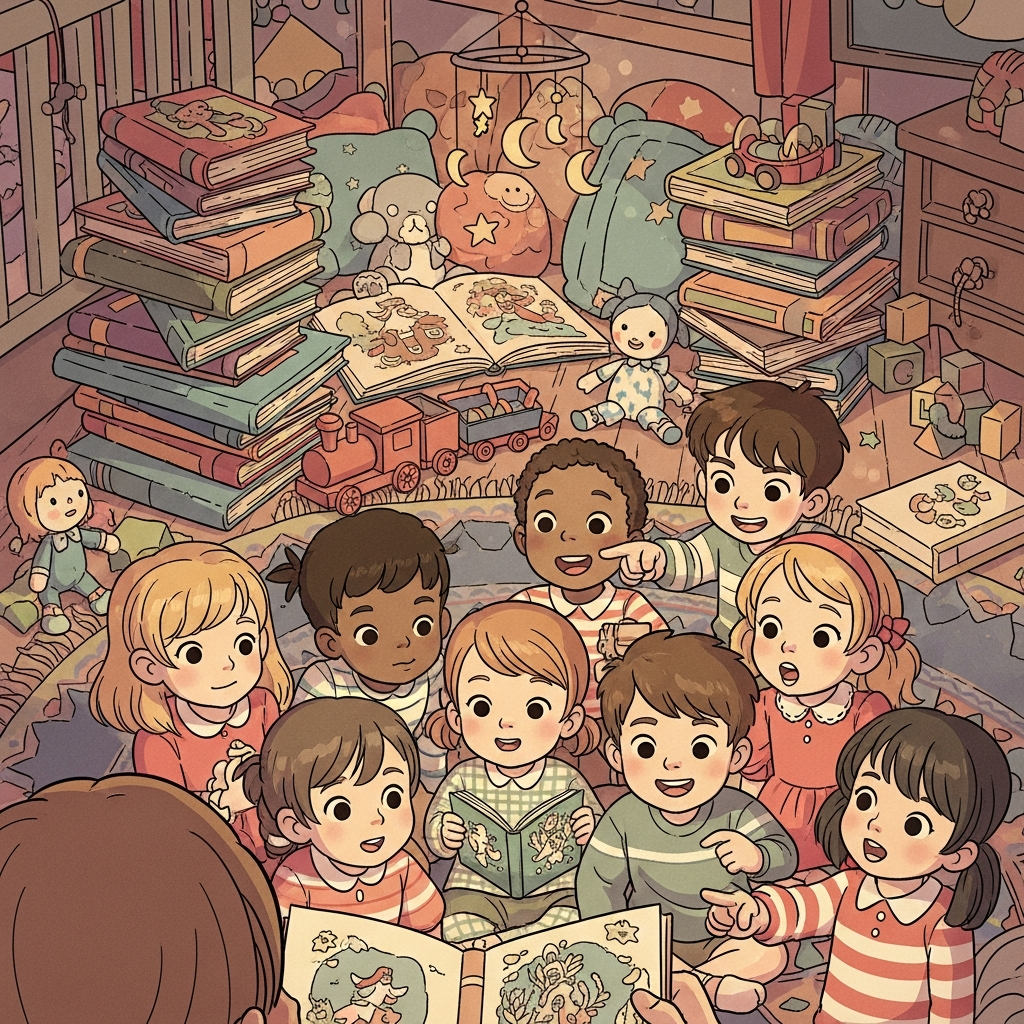
The quiet loss happening in bilingual families—and how narrative authenticity rebuilds cultural fluency
Discover why passive language exposure fails bilingual children and how storytelling creates the emotional connection that makes heritage languages feel like belonging, not homework.
Zusammenfassung
Passive exposure isn't enough - Your heritage language competes against an entire ecosystem; it needs intentional, meaningful presence.
Stories beat vocabulary drills - Children embrace languages that feel like belonging, not homework. Narrative authenticity creates emotional connection.
Bedtime is inheritance - Every story in your language threads your child to grandparents, homeland, and a whole version of themselves.
The stakes are generational - Lose the language, lose access to half of who they are. Stories are how you keep it alive.
The Story You Don't Tell Is the One They Forget
Your child knows the German word for butterfly. They learned it at Kita, sang it in a song, drew one with crayons.
But do they know your word for it? The one your grandmother used when she pointed to the garden? The one that carries the weight of a whole world they've never seen?
This is the quiet loss that happens in bilingual families. Not dramatic. Not sudden. Just a slow forgetting, one untold story at a time.
The Myth of Passive Exposure
We've been told that children absorb language like sponges. Just speak to them, the advice goes. They'll pick it up.
This belief became popular because it contains a grain of truth. Children do absorb language effortlessly, when that language surrounds them with meaning, emotion, and purpose.
But here's what the advice misses: your heritage language is competing against an entire ecosystem. German is everywhere. In school, on screens, in friendships. Your language lives in smaller spaces. Dinner conversations. Phone calls with relatives. Bedtime.
Passive exposure worked when villages raised children. It struggles in cities where your language has no structural support.
What Actually Preserves a Language
Here's what I believe: multilingual storytelling is the most powerful tool bilingual families have for building cultural fluency, because stories make language feel like belonging rather than homework.
Not vocabulary drills. Not grammar corrections. Stories.
Why Stories Carry What Conversations Cannot
A friend of mine, a Turkish mother in Berlin, told me about the moment she realized her daughter was losing Turkish. It wasn't a dramatic scene. Her daughter simply asked, "Mama, why do you talk funny sometimes?"
The language had become foreign in her own home.
She tried speaking more Turkish. It felt forced. Her daughter resisted. The language became associated with correction, with effort, with being different in the wrong way.
Then she started telling stories. Not reading them (there weren't enough Turkish children's books she loved). Telling them. Stories from her childhood. Made-up adventures. Tales where her daughter was the hero, navigating worlds that felt both magical and familiar.
Something shifted. Turkish stopped being "Mama's other language" and became the language of adventure. Of bedtime magic. Of belonging to something larger.
This isn't just anecdote. Research shows people are 22 times more likely to remember facts delivered through story than as isolated information. Language acquisition follows the same principle. Words stick when they're wrapped in meaning.
Roughly half the world's population speaks more than one language. Yet most children's content assumes monolingualism. The stories that shape imagination, that children ask for again and again, rarely come in the languages that matter most to immigrant families.
This gap isn't just inconvenient. It sends a message: your language isn't important enough to have its own stories.
Narrative Authenticity Is Not Optional
Here's where many well-meaning solutions fail. Translation isn't the same as narrative authenticity.
You can translate "The Very Hungry Caterpillar" into any language. But the cultural references, the rhythm, the way a story breathes, these don't translate automatically. A story that feels natural in German can feel stilted in Portuguese or Arabic or Vietnamese.
Children sense this. They know when a story belongs to them and when it's been borrowed from somewhere else.
True cultural fluency comes from stories that feel native to a language. Stories where the hero's name sounds like theirs. Where the world reflects something they recognize, even if they've never visited it.
Storytelling that achieves this kind of authenticity improves emotional connection by roughly 30%. For children building their sense of identity, that connection matters more than any vocabulary list.
What This Means for Your Family
If this perspective holds, then the question isn't whether to expose your child to your heritage language. It's whether that exposure feels like a gift or an obligation.
Every time your child hears a story in your language, where they are the hero, where the world reflects your shared heritage, they receive a message: this language is yours. This culture is yours. You belong here.
Every time they only encounter your language in corrections ("Say it properly") or obligations ("Talk to Oma"), they receive a different message: this language is work.
The stakes are generational. About 74 million Americans speak a non-English language at home, often specifically to preserve cultural identity. In Germany, the numbers tell a similar story. These families aren't being sentimental. They understand that language carries memory, worldview, connection to relatives across oceans.
Lose the language, and you lose access to half of who you are.
A Different Way to See Bedtime
Think of bedtime not as a routine but as a ritual of inheritance.
Every story you tell in your language is a thread connecting your child to grandparents they may rarely see, to a homeland they may never live in, to a version of themselves that exists in two worlds at once.
This is the gift of presence that matters most: not just being there, but being there with the full weight of who you are. Your language. Your stories. Your world.
Multilingual storytelling isn't about raising bilingual children. It's about raising children who feel whole.
The Story That Stays
Your child will forget most of what you tell them.
But they will remember how your language made them feel. Whether it was the language of magic or the language of homework. Whether it was theirs or yours.
You get to decide which story they carry.
Frequently Asked Questions
How does multilingual storytelling differ from simply speaking two languages at home?
Speaking two languages provides exposure, but storytelling wraps language in emotion and meaning. Children remember and embrace a language when it's connected to adventure and belonging, not just daily conversation.
At what age should I start telling stories in my heritage language?
From birth, but the magic window is 2 to 7 years old. This is when children are most receptive to language patterns and when stories shape their sense of identity most powerfully.
What if I'm not a natural storyteller?
You don't need to be. Personalized audio stories can carry the weight while you're tired, and your child still hears their name in your language, in adventures that feel like home.